Learn English With Short Stories: The Method That Actually Builds Vocabulary
If you grew up learning English from textbooks, you probably know the feeling.
You memorize a list of irregular verbs. You drill the present perfect. You pass the test. Two weeks later, you can't form the sentence you need in conversation, and the verbs you memorized have already left your head.
This is the problem with how most people learn English. You learn the language as a puzzle to be solved instead of a thing to be used.
The fix isn't another grammar app. It's short stories.
Here's why the method works and exactly how to use it.
The textbook trap
Textbooks teach English grammar in a tidy order — present simple, present continuous, past simple, present perfect — as if a real conversation goes through them in sequence.
It doesn't.
Real English mixes everything together. A native speaker switches between tenses three times in a single paragraph without noticing. They drop subjects when context makes them obvious. They use contractions, slang, idioms that no textbook lesson prepared you for.
When you only learn from textbooks, you build a grammar that exists nowhere except in textbooks. That's why your test scores look fine but your speech feels stiff.
Stories teach you English the way English is actually used.
Why short stories beat any drill
Here's what reading a story does that no app can.
It gives you a word ten times in different contexts. The first time you see reluctant, you guess what it means from the sentence. The third time, you start to feel it. By the tenth time — in a different chapter, said by a different character, in a different mood — the word is yours. You didn't memorize it. You absorbed it.
Apps give you reluctant once, with a translation, and call it done. Your brain doesn't even bother to retain it because no story is depending on it.
Stories also force you to handle grammar in the wild. You see past tense and present tense in the same paragraph. You see relative clauses you'd never construct in an exercise. You learn what English sounds like when it's flowing, not what it looks like in a workbook.
This is also the cleanest way to improve reading comprehension. The skill of scanning English text quickly and understanding it without translating in your head — that doesn't come from quizzes. It comes from volume. Reading a lot. And short stories are the format that gets you to volume without exhausting you.
The "I'm not good enough yet" trap
The biggest mistake intermediate learners make is thinking they need to be near-fluent before they can read.
That's backwards. Reading is how you get to fluent.
You don't need to read Shakespeare. You don't even need to read full novels. You need short stories at your level — meaning roughly 90% of the words are familiar, with a few new ones per page that you can guess from context.
A2-B1 readers should look for stories with simple sentence structures: short sentences, clear subjects, common tenses. Detective stories, light romance, slice-of-life — anything that pulls you forward to find out what happens next.
B2 and above can handle more complex prose: longer sentences, mixed tenses, dialogue with regional voice. Try short stories from real authors — Roald Dahl, Saki, O. Henry, Edgar Allan Poe — they wrote tight, plot-driven pieces with vocabulary you can mostly handle.
The trick is staying in the zone where it's slightly hard but never impossible.
The simple routine
Here's a daily practice that actually works for serious learners.
Pick a topic you'd actually want to read about in your native language. Sports, mystery, food, music, technology — anything. The interest is what keeps you reading on tired days.
Read for twenty minutes. Set a timer. When the timer ends, stop, even if you want to keep going. That trick makes it sustainable.
Don't look up every word. Look up only the ones you can't guess from context after two tries. Translating every word is what kills the joy of reading and slows your brain's pattern-matching.
Read the same story twice. The first read is for decoding. The second read is for absorbing. The comprehension jump between read one and read two is bigger than a week of grammar drills.
After reading, try to retell what happened in your own words, out loud, in English. This is where reading starts feeding your English conversation skills. The vocabulary and phrasing transfer from page to speech naturally because you've heard them in your head over and over.
Where to find stories at your level
This used to be the hard part. Graded readers are limited and outdated. Children's books are deceptively hard because they assume cultural fluency. News articles are too dry, novels too long.
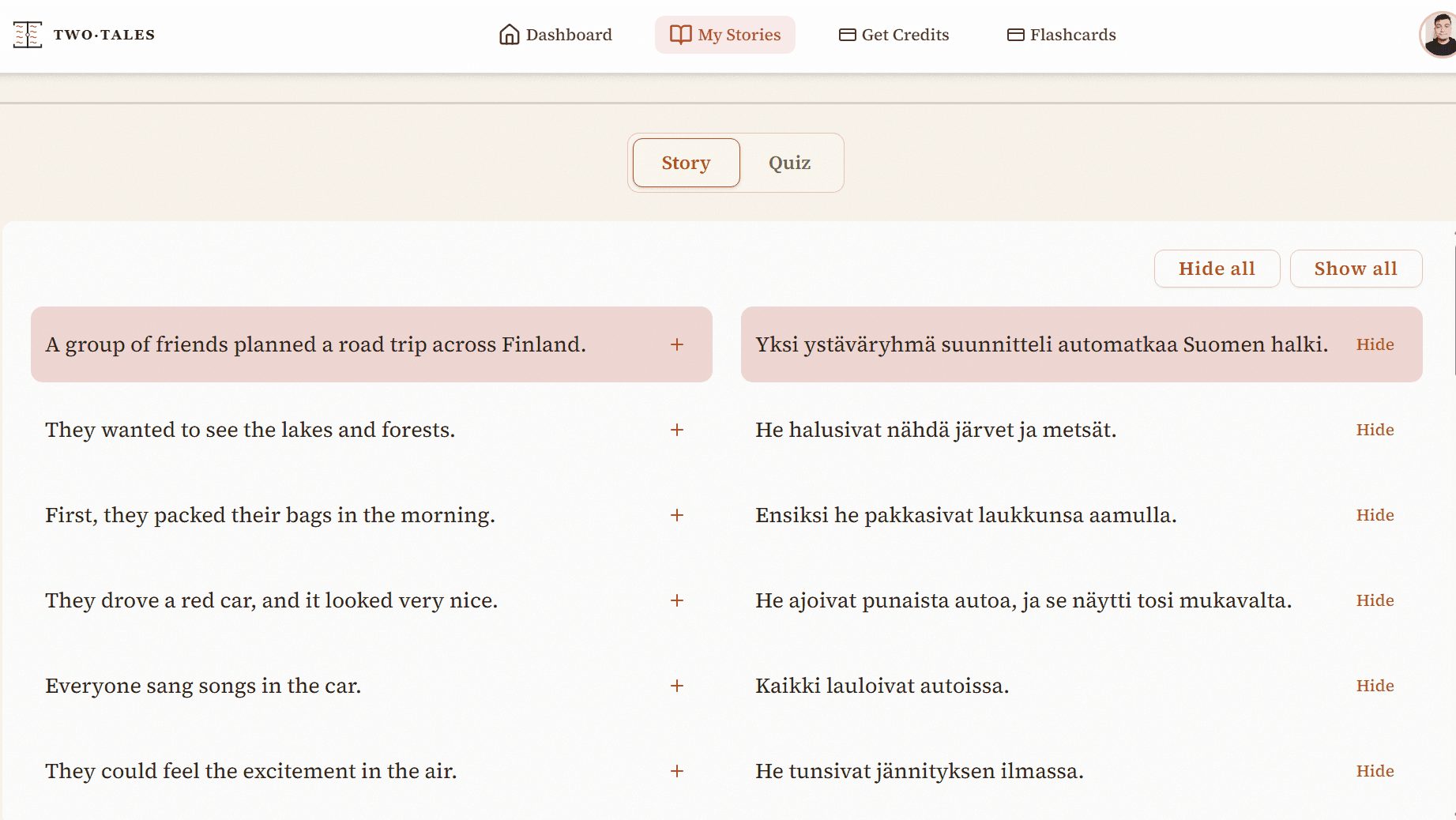
TwoTales solves it directly. You generate short stories in English at your exact level, A1 to C2, on any topic you choose. The translation in your native language sits right next to the English text, so when a word stops you, you check it without breaking your flow. Read, pause, glance, keep reading.
It's the cleanest form of English reading practice available, and the variety means you'll never get stuck reading the same kind of story over and over.
The bigger picture
Most English learners spend years in app-and-textbook mode and wonder why they don't sound natural.
The answer is exposure. You need real English in your eyes and ears every day, told in shapes that interest you, repeated naturally across stories and contexts.
That's it. There's no secret method. Just consistent reading of material you actually want to read.
Stop drilling. Start reading. Twenty minutes a day. You'll know the difference in a month.