Why Short Stories Beat Duolingo for Learning Spanish Vocabulary
You can spend three years on Duolingo and still not be able to hold a conversation in Spanish.
A 900-day streak. Every color, every food, every day of the week memorized. The little owl very proud of you. And then a real-world moment — ordering coffee, asking for directions, trying to small-talk a stranger — and none of the phrases drilled into your head fit the situation.
That's the moment most language learners hit eventually. And it points at something nobody on YouTube wants to admit: apps teach you to match words to translations. They don't teach you Spanish.
For that, you need short stories.
The vocabulary problem nobody talks about
Here is what learning Spanish vocabulary actually requires.
You need to see a word ten or fifteen times, in different sentences, in different contexts, before your brain tags it as "important." That's not a hot take. It's how memory works. The difference between recognizing a word and using it comes from variety, not repetition.
Duolingo gives you a word in one sentence, drills it five times in the same sentence pattern, and moves on. You finish the unit thinking you know encontrar. You don't. You know encontrar sandwiched between a subject and object in a present-tense sentence about meeting friends at a park.
In the real world, encontrar shows up in past tenses, in reflexive forms, in idioms like no me encuentro bien — "I don't feel well." Nothing in the app prepared you for any of that.
Short stories do.
Why short stories actually work
When you read a story, even a simple one, you see Spanish doing what Spanish actually does. Tenses bump up against each other. Subjects get dropped because Spanish drops subjects. Idioms slip in without warning.
And because there's a story — characters, a plot, a question you want answered — your brain isn't bored. That matters more than anyone admits. The reason you can't remember the word for "bridge" after the Duolingo drill is that your brain didn't care about the drill. It cares about the fox who needs to cross the lake before sunset.
This is also how you actually improve reading comprehension. Not the "translate this paragraph" exercise from high school. The real skill: scanning Spanish text and understanding what's happening as fast as you understand English. That only comes from volume, and short stories are the only format that gets you to volume without burning you out.
"But I'm a beginner"
This is the objection that kills it for most people. They walk into a Spanish bookstore, pick up Cien años de soledad, read four sentences, and quit forever.
You're not supposed to read García Márquez at A2. You're supposed to read simple stories — written for your level, with vocabulary you can mostly handle and a few unfamiliar words per page that you can guess from context.
A useful rule: if you understand about 90% of the words on a page, you're at the right level. That last 10% is where the actual learning happens. Anything harder and you're translating word by word and exhausting yourself. Anything easier and you're not stretching.
The hard part used to be finding stories at your exact level. For decades, Spanish learners had three options: textbook dialogues (boring), children's books (often weirdly difficult because they assume fluency), or graded readers (a handful exist, mostly outdated).
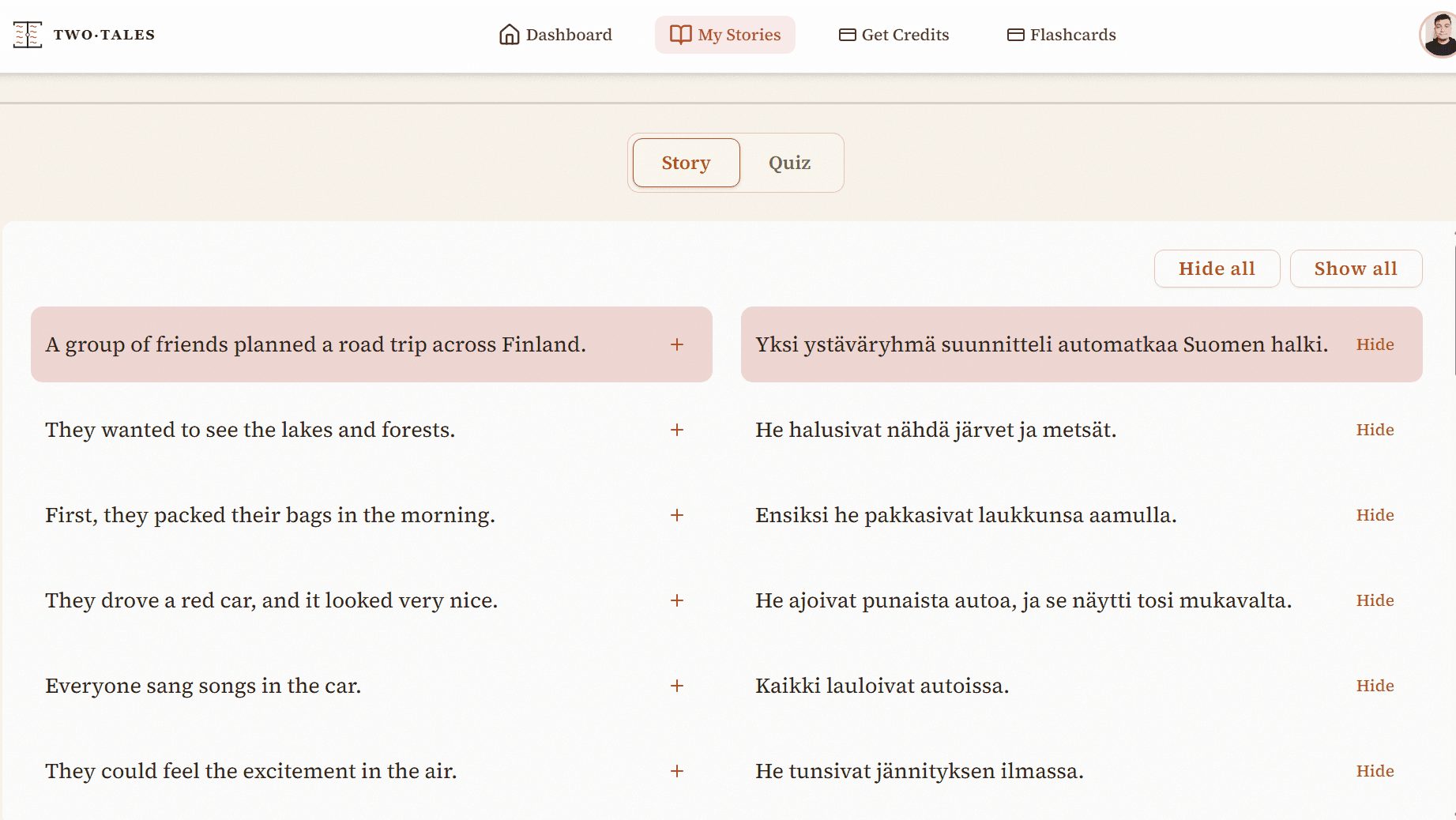
That's the gap TwoTales fills. You pick what you are interested in — soccer, true crime, fantasy, cooking, whatever — and you get a Spanish short story at your level, with English right next to it when you get stuck. No flipping to a glossary. No translation tab in Chrome. Just reading.
How to actually start
Here's a routine that works.
Read for fifteen minutes a day. Not an hour. Fifteen minutes. You'll do it consistently if it's short.
Don't translate every word. If you can guess from context, keep moving. The brain learns words faster when it's working for them.
Read the same story twice. The first time, you're decoding. The second time, you're reading. The jump in comprehension between read one and read two is bigger than anything an app will ever give you.
Mix the topics. One short detective story this week, a science fiction snippet next, a recipe the week after. Variety teaches you that Spanish isn't a textbook. It's a language people use to talk about everything.
And let Duolingo go, or at least demote it. There's nothing wrong with the app for keeping you in contact with the language on a slow day. But it isn't going to make you fluent. Reading will.
The same method works for English learners
A note for English learners reading this: the principle is identical.
If you're trying to learn English vocabulary, learn English grammar, or improve your reading comprehension, drop the apps and find short stories in English at your level. The brain doesn't care which language you're feeding it. It cares about engagement, repetition, and context. Daily English reading practice will move you further in a month than a year of streak-keeping.
It also feeds English conversation more than people expect. When you read fluently, the patterns and phrasing transfer to your speech. You start to sound like the people in the stories, because their grammar is in your head now.
TwoTales generates stories in both directions — Spanish for English speakers, English for Spanish speakers, and other pairs too. The method is universal.
Stop drilling. Start reading.
If you've spent a year in app-jail and your Spanish hasn't moved, take that as your signal.
You don't need more drills. You need to read Spanish that you actually want to read. Pick a topic you'd happily read about in English. Get a story at your level. Read for fifteen minutes.
Try it for a week. You'll know.